Lorem ipsum dolor sit amet, consectetur adipiscing elit lobortis arcu enim urna adipiscing praesent velit viverra sit semper lorem eu cursus vel hendrerit elementum morbi curabitur etiam nibh justo, lorem aliquet donec sed sit mi dignissim at ante massa mattis.
Vitae congue eu consequat ac felis placerat vestibulum lectus mauris ultrices cursus sit amet dictum sit amet justo donec enim diam porttitor lacus luctus accumsan tortor posuere praesent tristique magna sit amet purus gravida quis blandit turpis.
At risus viverra adipiscing at in tellus integer feugiat nisl pretium fusce id velit ut tortor sagittis orci a scelerisque purus semper eget at lectus urna duis convallis. porta nibh venenatis cras sed felis eget neque laoreet suspendisse interdum consectetur libero id faucibus nisl donec pretium vulputate sapien nec sagittis aliquam nunc lobortis mattis aliquam faucibus purus in.
Nisi quis eleifend quam adipiscing vitae aliquet bibendum enim facilisis gravida neque. Velit euismod in pellentesque massa placerat volutpat lacus laoreet non curabitur gravida odio aenean sed adipiscing diam donec adipiscing tristique risus. amet est placerat in egestas erat imperdiet sed euismod nisi.
“Nisi quis eleifend quam adipiscing vitae aliquet bibendum enim facilisis gravida neque velit euismod in pellentesque massa placerat”
Eget lorem dolor sed viverra ipsum nunc aliquet bibendum felis donec et odio pellentesque diam volutpat commodo sed egestas aliquam sem fringilla ut morbi tincidunt augue interdum velit euismod eu tincidunt tortor aliquam nulla facilisi aenean sed adipiscing diam donec adipiscing ut lectus arcu bibendum at varius vel pharetra nibh venenatis cras sed felis eget dolor cosnectur drolo.
In manufacturing, nothing is more critical than the safety of your people. It is a non-negotiable principle, a foundational element of a strong and ethical business. For decades, safety management has relied on a combination of rigorous training, paper checklists, and posters on the factory floor. While these methods have reduced incidents, they are inherently limited. They often fail to account for human error, fatigue, or the complexities of a high-speed, dynamic environment.
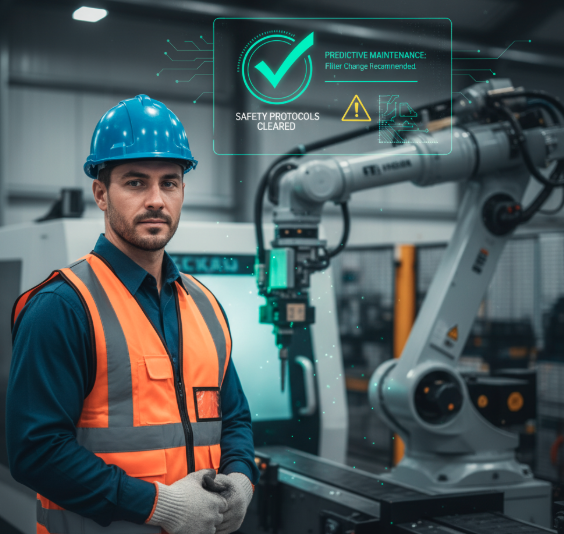
Today, a new era of safety is emerging, powered by artificial intelligence. AI is moving safety from a reactive, compliance-focused activity to a proactive, real-time function that is seamlessly integrated into every step of a frontline operation. This shift not only protects your most valuable asset—your people—but also strengthens your entire business.
Traditional safety is about checking a box. AI-powered safety is about preventing an accident before it has a chance to occur.
Compliance with safety regulations is a complex, data-intensive process. A digital, AI-powered system simplifies this dramatically. Every safety check, every sign-off, and every protocol is automatically documented in a central, unalterable database.
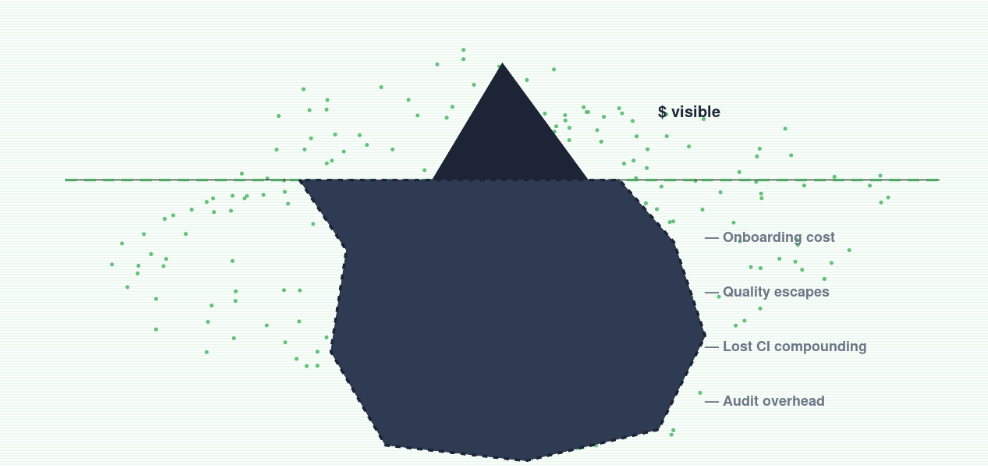
An investment in safety is a direct investment in your bottom line. While hard to quantify, the returns are substantial. A safer factory floor leads to:
The future of manufacturing safety is not about passive rules; it is about an active, intelligent, and integrated system that protects your people and your business. By leveraging AI, you can build a safety culture that is both compassionate and strategically sound, creating a more resilient, compliant, and productive operation for years to come.
Book a free demo of our application and see how it can take your manufacturing operations to the next level.