Lorem ipsum dolor sit amet, consectetur adipiscing elit lobortis arcu enim urna adipiscing praesent velit viverra sit semper lorem eu cursus vel hendrerit elementum morbi curabitur etiam nibh justo, lorem aliquet donec sed sit mi dignissim at ante massa mattis.
Vitae congue eu consequat ac felis placerat vestibulum lectus mauris ultrices cursus sit amet dictum sit amet justo donec enim diam porttitor lacus luctus accumsan tortor posuere praesent tristique magna sit amet purus gravida quis blandit turpis.
At risus viverra adipiscing at in tellus integer feugiat nisl pretium fusce id velit ut tortor sagittis orci a scelerisque purus semper eget at lectus urna duis convallis. porta nibh venenatis cras sed felis eget neque laoreet suspendisse interdum consectetur libero id faucibus nisl donec pretium vulputate sapien nec sagittis aliquam nunc lobortis mattis aliquam faucibus purus in.
Nisi quis eleifend quam adipiscing vitae aliquet bibendum enim facilisis gravida neque. Velit euismod in pellentesque massa placerat volutpat lacus laoreet non curabitur gravida odio aenean sed adipiscing diam donec adipiscing tristique risus. amet est placerat in egestas erat imperdiet sed euismod nisi.
“Nisi quis eleifend quam adipiscing vitae aliquet bibendum enim facilisis gravida neque velit euismod in pellentesque massa placerat”
Eget lorem dolor sed viverra ipsum nunc aliquet bibendum felis donec et odio pellentesque diam volutpat commodo sed egestas aliquam sem fringilla ut morbi tincidunt augue interdum velit euismod eu tincidunt tortor aliquam nulla facilisi aenean sed adipiscing diam donec adipiscing ut lectus arcu bibendum at varius vel pharetra nibh venenatis cras sed felis eget dolor cosnectur drolo.
For over half a century, the philosophy of continuous improvement has been the engine of operational excellence in manufacturing. From Kaizen events to Six Sigma methodologies, the core idea is simple yet powerful: to consistently and incrementally improve processes, quality, and efficiency. However, in most organizations, this is still a manual, time-consuming, and often fragmented process. Teams spend countless hours on Gemba walks, collecting data on clipboards, and manually analyzing spreadsheets—a slow and laborious process that can delay insights and action.
Today, the most forward-thinking manufacturers are accelerating this cycle with AI. By integrating AI-powered platforms into frontline operations, they are transforming a sporadic, manual effort into an automated, data-driven, and continuous cycle of excellence that never stops.
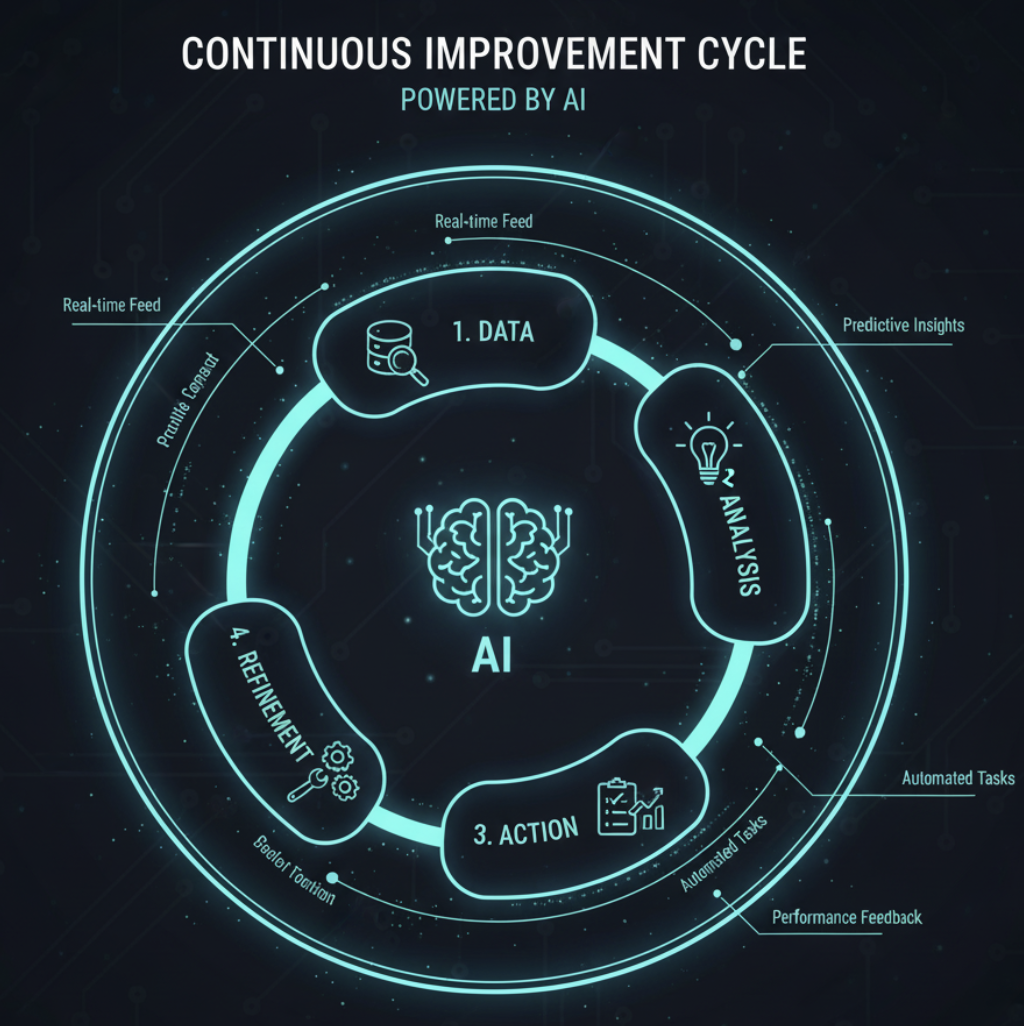
The first and most critical step in continuous improvement is accurate, real-time data. Traditional methods are prone to human error, delays, and a lack of granularity. A digital, AI-driven platform solves this by making data collection an invisible, integrated part of daily work. Every time a worker completes a step in a digital work instruction, a data point is automatically created. This includes metrics on task duration, tool usage, error rates, and more. This automated data collection provides a foundational layer of truth, ensuring that every insight is based on a precise, comprehensive view of what is truly happening on the factory floor.
With a constant stream of data, the next step is to make sense of it. This is where AI acts as the engine of continuous improvement. The AI can process and analyze millions of data points, revealing patterns and opportunities that would be impossible for a human to spot.
Insight without action is useless. An AI-powered continuous improvement system turns insights into actionable interventions. When the AI identifies an inefficiency, it can trigger an automated action. This could be a recommendation for a new, optimized workflow for a specific product, a targeted training module for a team struggling with a particular task, or a maintenance alert for a machine showing signs of performance degradation. This real-time, targeted intervention ensures that improvements are not just discussed in a meeting but are implemented directly on the factory floor.
The cycle closes with a critical feedback loop. After a change has been implemented, the AI continues to monitor its impact. Did the new workflow reduce cycle time as expected? Did the new training module reduce the error rate? The system provides a clear, data-driven answer, verifying the success of the improvement and identifying areas for further refinement. This completes the cycle, paving the way for the next round of insights and improvements.
By automating this entire process, manufacturers can transform continuous improvement from a manual, sporadic effort into a relentless pursuit of excellence. This ensures that every operation is not just efficient today but is perpetually optimizing for a more productive, resilient, and profitable tomorrow.
Book a free demo of our application and see how it can take your manufacturing operations to the next level.