Lorem ipsum dolor sit amet, consectetur adipiscing elit lobortis arcu enim urna adipiscing praesent velit viverra sit semper lorem eu cursus vel hendrerit elementum morbi curabitur etiam nibh justo, lorem aliquet donec sed sit mi dignissim at ante massa mattis.
Vitae congue eu consequat ac felis placerat vestibulum lectus mauris ultrices cursus sit amet dictum sit amet justo donec enim diam porttitor lacus luctus accumsan tortor posuere praesent tristique magna sit amet purus gravida quis blandit turpis.
At risus viverra adipiscing at in tellus integer feugiat nisl pretium fusce id velit ut tortor sagittis orci a scelerisque purus semper eget at lectus urna duis convallis. porta nibh venenatis cras sed felis eget neque laoreet suspendisse interdum consectetur libero id faucibus nisl donec pretium vulputate sapien nec sagittis aliquam nunc lobortis mattis aliquam faucibus purus in.
Nisi quis eleifend quam adipiscing vitae aliquet bibendum enim facilisis gravida neque. Velit euismod in pellentesque massa placerat volutpat lacus laoreet non curabitur gravida odio aenean sed adipiscing diam donec adipiscing tristique risus. amet est placerat in egestas erat imperdiet sed euismod nisi.
“Nisi quis eleifend quam adipiscing vitae aliquet bibendum enim facilisis gravida neque velit euismod in pellentesque massa placerat”
Eget lorem dolor sed viverra ipsum nunc aliquet bibendum felis donec et odio pellentesque diam volutpat commodo sed egestas aliquam sem fringilla ut morbi tincidunt augue interdum velit euismod eu tincidunt tortor aliquam nulla facilisi aenean sed adipiscing diam donec adipiscing ut lectus arcu bibendum at varius vel pharetra nibh venenatis cras sed felis eget dolor cosnectur drolo.
For thirty years, the most valuable operational dataset in a manufacturing business was the ERP. The financials lived there, the inventory lived there, the orders lived there. Every conversation about manufacturing data started with "is it in SAP?"
That's still true for some questions. It's no longer true for the questions that determine whether a plant is competitive. The most valuable operational data in a modern manufacturer is increasingly the shopfloor data — and most companies are barely beginning to act on it.
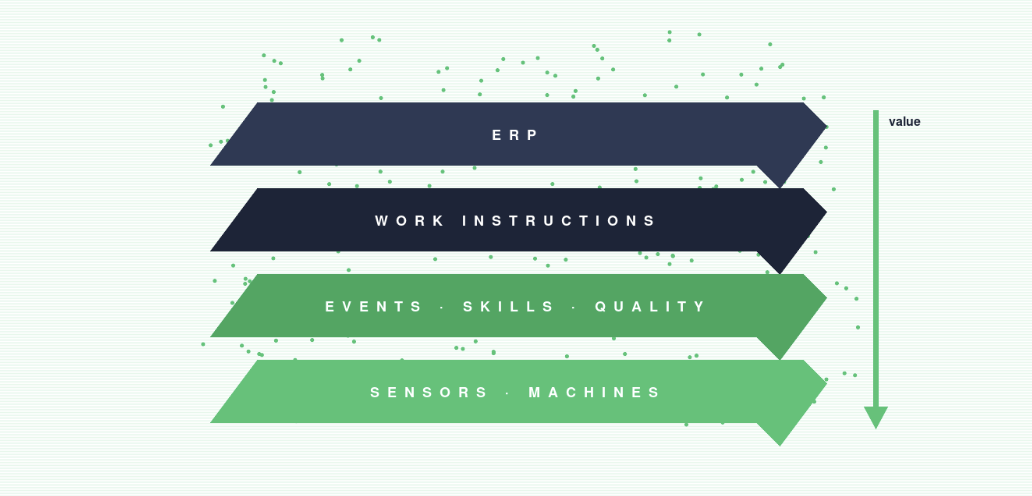
ERP tells you what happened. Shopfloor tells you why. The ERP is excellent at recording the outcome — an order was placed, a part shipped, inventory moved. What it doesn't capture is the operational reality underneath: actual cycle time, which operator ran it, which fixture was loaded, which exceptions came up, which checks were confirmed. Diagnosing why margin is shifting on a product line is not an ERP exercise. The ERP confirms the shift. The shopfloor data tells you whether the cause is operator mix, fixture wear, recipe drift, or rework.
ERP is structurally lagging. Shopfloor data is real-time. The ledger is accurate after the fact — it's not how you steer. The shopfloor data layer, when built well, is real-time and event-rich. The line stopped this minute. The check failed, this part. With context attached, the operation course-corrects now rather than reading about a problem in next month's variance review.
ERP doesn't model people. Modern manufacturing is people-constrained. The ERP knows an order shipped on time. It does not know that on the day it was made, the qualified operator was on leave, the substitute had only run two of these the prior week, and the line ran 12% slower as a result. That's shopfloor data — work execution, skills, sign-off — and it's the data you need to manage a people-constrained operation.
ERP is rear-view. Shopfloor data is the engine for AI. The current generation of AI tools — predictive maintenance, anomaly detection, intelligent scheduling, in-step assistance — runs on the kind of data the ERP doesn't have. Plants that have invested in capturing structured shopfloor data have a substrate AI can work with. Plants that haven't are stuck with a system that's great for invoicing and ill-suited for adaptive control.
The strategic question is no longer "what's our ERP roadmap." It's "what's our operational data roadmap, of which the ERP is one component." Plants that haven't yet built this layer have an asset gap they haven't been measuring — and it's widening every quarter another plant builds it.
Book a free demo of our application and see how it can take your manufacturing operations to the next level.